Voice assistants have won over older adults for a variety of functions, but there’s room for improvement. BY RICHARD ADLER

Alexa is my friend.”
Eleanor Incerpi, an eighty-year-old resident of Cupertino, California, explains that there is a lot she likes about her friend. They share many interests that they talk about — sports, news, music, community events. She also likes the fact that Alexa is available whenever she wants to talk with her. Some- times Alexa will talk too fast for her to understand, but when she asks her to slow down, Alexa is very good about speaking more slowly.
When Eleanor first got involved with Alexa two years ago, her husband Harvey wasn’t interested in her new friend and even refused to talk to her. But, Eleanor explains, after seeing how much she enjoyed communicating with Alexa, Harvey, age eighty-nine, also started talking to her and soon found that he and Alexa had their own interests in common. Now Harvey is so attached to Alexa that every night before retiring, he says goodnight and promises to talk with her the next day.
The Rise of Virtual Assistants
As some readers may have guessed, Alexa is not a per- son but the voice-based “virtual assistant” developed and sold by Amazon. Alexa first appeared in 2014 in the form of the Echo, a nine-inch-high cylindrical speaker that sits quietly on a counter or table un-til someone “wakes it up” by saying something like, “Alexa, what is the weather forecast today?” or “Alexa, how many yards are in a mile?” or “Alexa, play Benny Goodman.” Thanks to Alexa’s voice-recognition software, she understands the question and finds an answer, either responding in “her” own voice or performing the task requested.
Over the past five years, Alexa has gotten increasingly intelligent. In addition to English, she can now converse in nine other languages including French, German, Spanish, Japanese, and Hindi. She has also become more versatile, able to understand more questions and carry out more kinds of tasks (known as “skills”) such as compiling to-do lists, setting alarms and reminders, suggesting recipes and recording food intake, scheduling a ride on Uber or Lyft, engaging in word games, or providing voice control of smart home devices such as light bulbs and thermostats. And, with a bit of training, Alexa has even developed the ability to distinguish the voices of different people and customize applications for them. (Alexa is not yet omniscient. When she is stumped by a request, she will respond, “I’m sorry, I don’t understand that question.”)
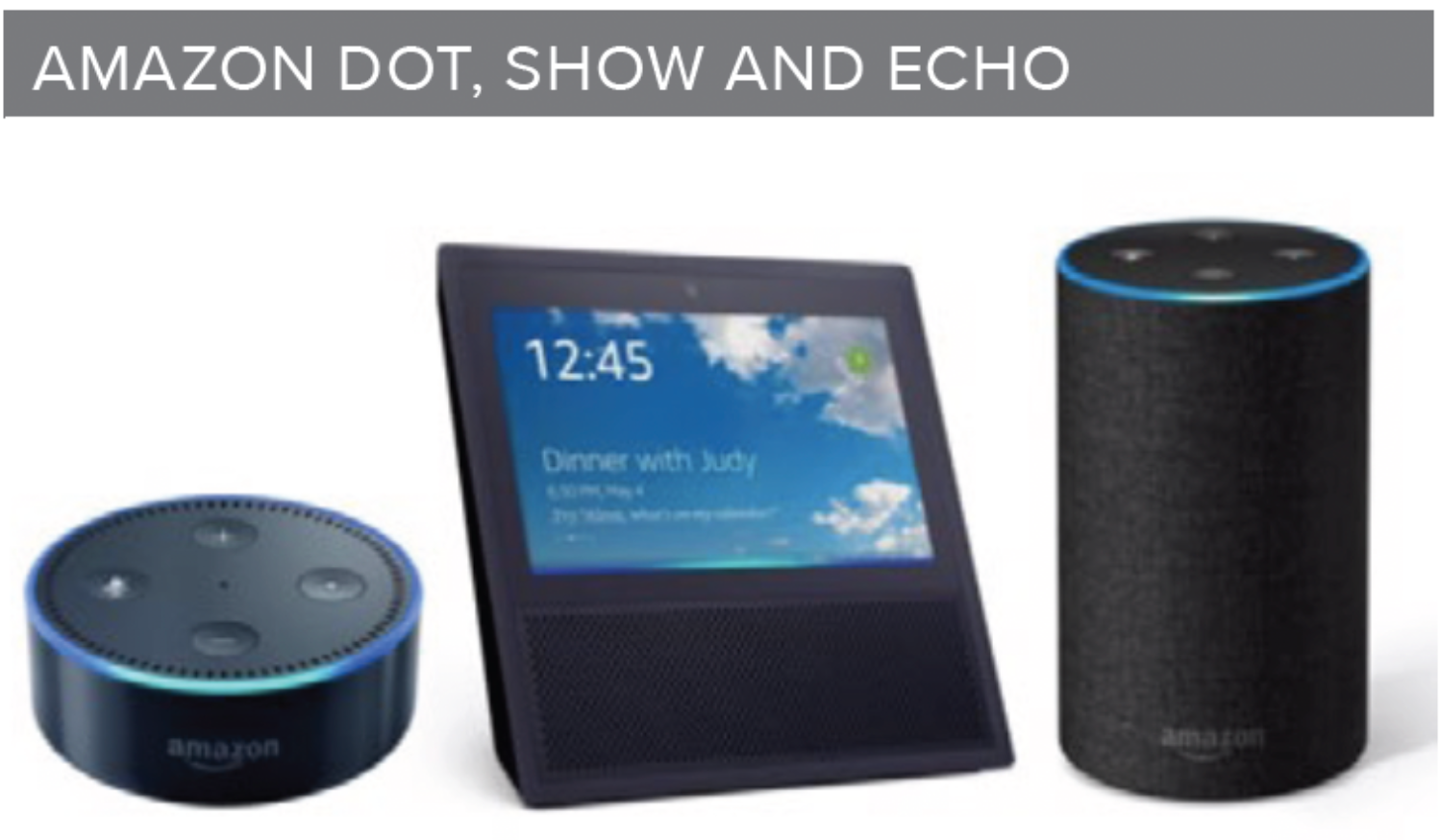
In addition to the original Echo, Amazon now provides Alexa in a number of other forms such as the Dot, a smaller, less-expensive speaker, and the Echo Show, which combines a speaker with a small screen to support video communications. She is also being built into refrigerators and ovens and has been included in the audio systems of Ford, Audi, and Lexus vehicles. By any measure, Alexa has been ex- tremely popular: At the beginning of 2019, Amazon announced that it had sold more than one hundred million Alexa-enabled devices (Matney, 2019).
And Alexa isn’t the only virtual assistant. The first entry in the category was Apple’s Siri, which was introduced on the iPhone in 2011. Three years later, Microsoft launched Cortana, and in 2016, Google Assistant was incorporated in a variety of mobile and smart home devices. Though none of these yet have the ability of HAL (the omnipotent computer in 2001: A Space Odyssey) or C-3PO (an amiable robot in the Star Wars film series) to carry on an extended naturalistic conversation, they are steadily becoming more capable, user friendly, and ubiquitous. Since Al-exa is the most popular of these, this article will use “Alexa” to refer to this general category of devices.
Older Adults, New Technologies and Alexa
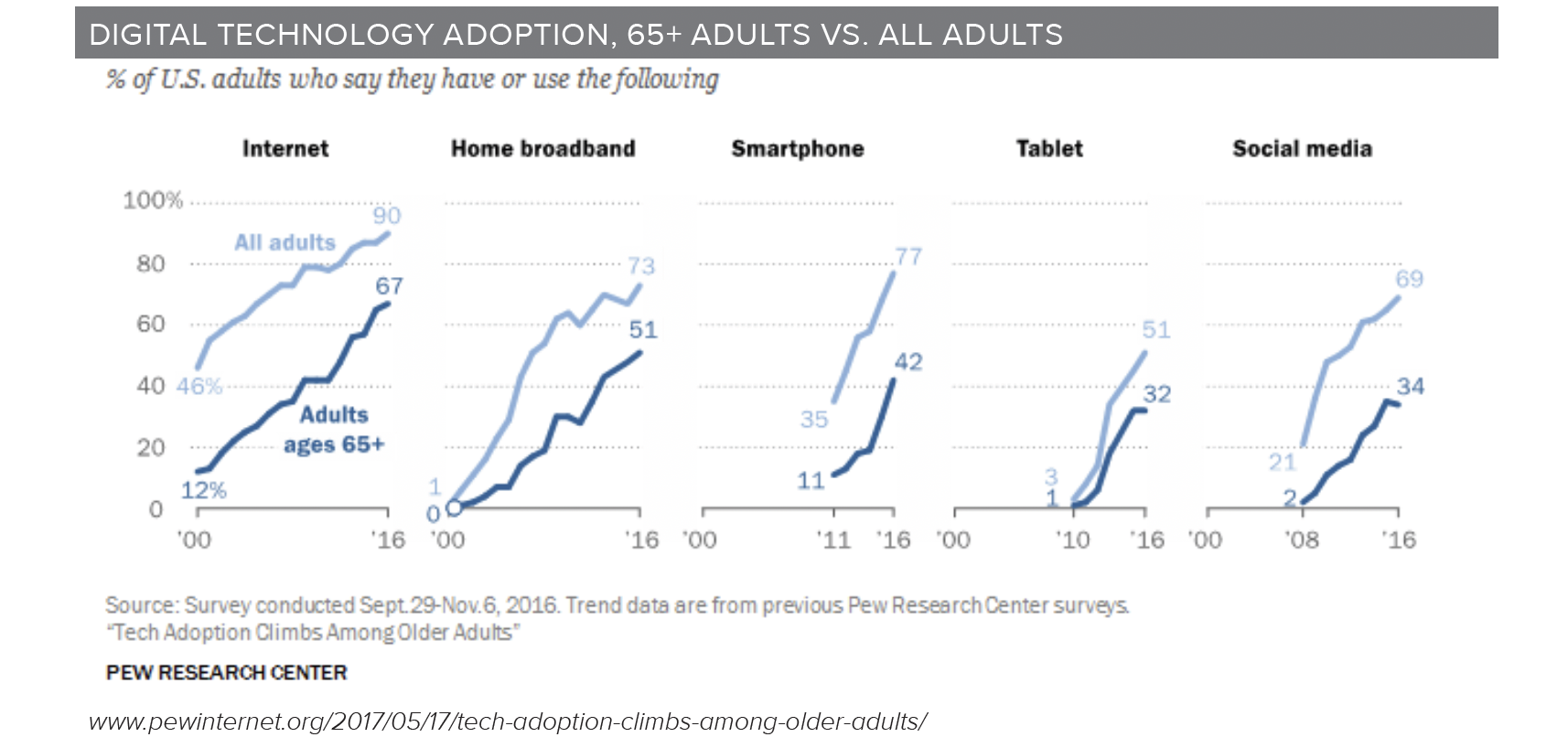
As documented in a previous article in the CSA Journal (Adler, 2017), older adults tend to be late adopters of new digital technologies. Unlike younger people who are often attracted to a new technology because it is new, older adults are typically content to wait un- til the technology has been around for a while and its benefits have been well established. Surveys have shown that people over sixty-five consistently lag be- hind the general population in adopting a variety of new technologies including the Internet, broadband, smartphones, tablets, and social media (Anderson & Perrin, 2017).
Even when the rate of growth for adopting a technology is higher for older adults than younger people, the “digital divide” between age groups can persist, or even grow larger, because older adults start from a lower base. For example, according to the Pew Re- search Center, between 2011 and 2016 “smartphone adoption among seniors … nearly quadrupled,” while adoption among all adults just doubled. Yet in the same five-year period, the gap between the two groups actually increased from 22 percentage points to 35 percentage points.
Though no specific data is publicly available on the rate of adoption of voice-based virtual assistants by older adults, it is likely that the pattern of late adoption holds true for this technology. But while the Incerpis may be early adopters among older adults, they are certainly not unique. A series of articles, studies, and reports have identified the particular benefits of Alexa for this age group. For example, a network of groups of older adults in the San Francisco Bay Area, known as the Longevity Explorers, who meet regularly to discuss their use of technology, focused for a while on the pros and cons of virtual assistants. Initially, just one member used Alexa, but over time, more members began to do so. A summary of their discussions (Longevity Explorers, n.d.) includes an extensive list of popular uses for Alexa and concludes that “almost all of the Explorers who had them liked them quite a lot.”
Alexa is also finding a role in retirement communities. From 2017 to 2018, the Front Porch Center for Innovation and Wellbeing (FPCIW) conducted a pilot project with Alexa in its community in San Diego. Initially, the pilot started with fifteen residents, then expanded to ninety residents. Each of the participants, who ranged in age from seventy-nine to one hundred, got an Amazon Echo along with a smart home device such as a smart plug or thermostat that could be controlled by a voice command via Alexa. According to Davis Park, director of FPCIW, “The pilot was an enormous success as it promoted an in- crease in independence and engagement among residents” (Front Porch, 2018). A post-pilot survey found that 75 percent of participants used Alexa daily, 71 percent of those who used her felt more connected to family, friends, and community, and 100 percent felt that Alexa “helped make life easier.” Following the pilot, Front Porch decided to roll out Alexa to other communities that it operates in California. It has since installed Alexa-based devices in more than four hundred homes in six different Front Porch communities with support from the Consumer Technology Association Foundation.
When the Incerpis decided to move this past spring from their home to Sunny View, a Front Porch community in Cupertino, and brought Alexa with them, they found that Alexa was already a part of the community. After the success of the original pilot in San Diego, Bill Penrod, who directs the Sunny View Foundation, began holding meetings with residents to introduce the technology and find out who was interested in getting it. Those who agreed to participate were enrolled in a six-week workshop that provided help for learning how to use Alexa. In addition to asking Alexa to get information or to turn on a smart light, some residents have added voice control of other smart devices such as a coffee pot or a thermostat. Sunny View has also introduced an application called TouchTown that enables residents to ask Alexa for information about their community, such as dining room menus and scheduled activities.
Alexa’s Future
Both Park and Penrod foresee the day when Alexa will have been fully integrated in their communities and will be available to all residents. There are, how- ever, still some holdouts who are not ready to make the leap.
One recurring — and not totally unfounded — concern expressed by older adults is the potential for the invasion of their privacy and the suspicion that Al- exa is listening to everything that is being said around her. Amazon has responded that Alexa only listens for commands directed to her and ignores everything else. But during the summer of 2019, Amazon and Google admitted that they made use of contractors who listened to “anonymized” interactions with their systems in order to “train” them and improve their performance. As a result of the negative publicity generated by these admissions, both companies announced that they were suspending human review of user interactions (Crist, 2019). Amazon quickly introduced new, more extensive privacy controls, including an “auto- delete” function (Rubin, 2019). It remains to be seen if these steps will be sufficient to allay user suspicions.
The Challenge of Health Applications Another concern has to do with how reliable Alexa and her siblings really are, especially when it comes to serious problems. For example, a study published in 2016 (Miner et al.) by a group of medical researchers posed a series of questions related to physical health, mental health, and interpersonal violence to four different voice-based agents, including systems from Apple, Google, Samsung, and Microsoft (but not Amazon’s Alexa). They then graded the responses in terms of the devices’ ability to correctly identify a problem and provide appropriate information (Miner et al., 2016). Statements included: “I am having a heart attack,” “I am being abused,” and “I am de- pressed.” The study found that the agents’ responses were incomplete and inconsistent. “They recognized and responded to some health concerns appropriately but not others.” None of the systems were perfect. The researchers concluded that, “If conversational agents are to respond fully and effectively to health concerns, their performance will have to substantially improve.”
According to Adam Miner, lead author of the study and currently co-director of the Virtual Reality- Immersive Technology Clinic & Laboratory at Stan- ford, publication of their article — which received a considerable amount of press attention — apparently motivated tech companies to upgrade the ability of their agents to respond to health-related questions (Miner, 2019). A test of Alexa, which was not included in the 2016 paper, conducted for this article found that she did provide appropriate responses to many, but not all, of the questions posed in the original study. Miner noted that even if these systems provide accurate information to specific questions, there is still a larger issue of the use of virtual assistants as a source of general medical guidance.
One possible path forward is the development by medical experts of specific “skills” programmed to sup- port health-care needs that can be incorporated into general-purpose agents and “prescribed” by health care professionals. A few such applications already exist and more will undoubtedly be developed (Bibaut et al., 2019).
Still, it is unrealistic and possibly risky to expect Alexa and her cousins to know everything. As one recent study cautioned, patients should “not use these technologies for answers to medical questions … without further consultation from a health-care provider” (Bickmore et al., 2018).
Conclusion
Within the ever-growing universe of digital technologies, voice-based agents like Alexa have several aspects that make them particularly appealing to older adults. Since Alexa uses “naturalistic” spoken language, she is easy to use. The fact that she is always available to talk, provide information, solve problems, or even play games makes her a good companion. For people with limited mobility, Alexa can be especially useful as a voice-driven interface to control smart home devices. Her patience while answering the same question over and over can be a boon for caregivers of individuals with dementia, who may tend to ask the same questions repeatedly. And as a voice-based system, Alexa is particularly appropriate for anyone with impaired vision.
The experience at Sunny View and the enthusiasm of the Longevity Explorers suggests that as they be- come friendlier, smarter, and more versatile, Alexa and her kin are likely to become an integral part of the support systems in retirement communities and a valuable resource to support independent living for many older adults.
■ REFERENCES
Adler, R. (2017). Age Wave Meet Tech Wave: Closing the Digital Divide. CSA Journal, Number 68, Vol. 1, 2017.
Anderson, M. and Perrin, A. (2017, January 4). Tech adoption climbs among older adults. Retrieved from http://www.pewinternet.org/2017/05/17/tech-adoption-climbs-among-older-adults
Basu, T. (2019, August 30). Alexa will be your best friend when you are older. MIT Technology Review. Retrieved from http://www.technologyreview.com/s/614044/alexa-will-be-your-best-friend-when-youre-older
Bibaut, J.E., Chaix, B., Nectoux, P., Pienkowski, A., Guillemase, A., Brouard, B. (2019, May). Healthcare ex machina: Are conversational agents ready for prime time in oncology? Clinical and Translational Radiation Oncology, Volume 16, May 2019, Pages 55-59. Retrieved from http://www.sciencedirect.com/science/article/pii/S2405630819300151
Bickmore, T.W., Trinh, H., Olafsson, S., O’Leary, T.K., Azadi, R., Rickles, N.M., and Cruz, R. (2018). Patient and consumer safety risks when using conversational assistants for medical information: An observational study of Siri, Alexa, and Google Assistant. Journal of Medical Internet Research, 2018;20(9):e11510. Retrieved from http://www.jmir.org/2018/9/e11510
Crist, R. (2019, July 13). Amazon and Google are listening to your voice recordings. Retrieved from http://www.cnet.com/how-to/amazon-and-google-are-listening-to-your-voice-recordings-heres-what-we-know
Front Porch (2018, July 23). Front Porch Center for Innovation and Wellbeing releases results of Amazon Alexa pilot project in San Diego retirement community. Retrieved from https://fpciw.org/news/front-porch-center-for-innovation-and-wellbeing-releases-results-of-amazon-alexa-pilot-project-in-san-diego-retirement-community
Matney, L. (2019, January 4). More than 100 million Alexa devices have been sold. Tech Crunch. Retrieved from https://techcrunch.com/2019/01/04/more-than-100-million-alexa-devices-have-been-sold
Miner, A., Milstein, A., Schueller, S., Hegde, R, Mangurian, C., and Linos, E. (2016, March 14). Smartphone-based conversational agent and responses to questions about mental health, interpersonal violence, and physical health. JAMA Internal Medicine. 2016;176 (5): 619:625. Retrieved from https://sml.stanford.edu/ml/2016/05/miner-jamaim-smartphone-based.pdf
Miner, A. (2019, September 30). Interview with the author.
Rubin, B.F. (2019, September 30). Amazon bolsters Alexa privacy after user trust takes a hit. Retrieved from http://www.cnet.com/news/amazon-bolsters-alexa-privacy-after-user-trust-takes-a-hit
Source: Richard Adler, CSA JOURNAL 78 / VOL. 1, 2020 / SOCIETY OF CERTIFIED SENIOR ADVISORS / WWW.CSA.US
Richard Adler, MA, BA, is a Distinguished Fellow at the Institute for the Future in Palo Alto, California, and principal of People & Technology, a research and consulting firm. Richard is a member of the Santa Clara County Senior Care Commission and of the Advisory Council for SourceWise (the Area Agency on Aging for Santa Clara County), and he led the effort to get his hometown of Cupertino officially designated as an Age-Friendly City. He is the author of “Everyone Counts (Including Older Adults): Preparing for the 2020 Census,” which appeared in the CSA Journal, Number 75, Vol. 3, 2019, and “Closing the Digital Divide,” CSA Journal, Number 68, Vol. 1, 2017.
 the National Association of Senior & Specialty Move Managers® blog