Homeowners and designers have found ways to blend accessibility and aesthetics.
By Dina Cheney, the New York Times, November 2, 2025
Most older Americans want to age in place, electing to remain in their homes rather than move into senior housing facilities, according to a 2024 survey by AARP, the advocacy organization focused on older Americans. Yet fewer than 4 percent of American homes have basic accessibility features.
“It’s a really dire situation,” said Jennifer Molinsky, director of the Housing an Aging Society Program at Harvard’s Joint Center for Housing Studies.
Until flexible homes become the norm, most homeowners will need to retrofit their spaces. Common solutions, like aluminum ramps, clunky steel grab bars and motorized stair lifts, tend to be eyesores and constant reminders of mobility challenges. These institutional-looking features can also make seniors feel embarrassed or more vulnerable to crime.
“Many homes renovated to help people age are soulless,” said Ava Abramowitz, 76, who is the author of “The Architect’s Essentials of Negotiation” and a former deputy general counsel of the American Institute of Architects.
But some homeowners and designers believe they don’t have to choose between form and function.
Ms. Abramowitz, who is also a mediator for the District of Columbia federal courts and a lecturer at George Washington University Law School, and her husband, Neil Rackham, 82, who is an author and academic, are among those who wanted to find another way.


When they began conceptualizing a home they were building in Northern Virginia — with the firm Reader & Swartz as architect of record, along with the design-build firm Gruver Cooley and the landscape architecture firm River’s Edge Landscapes — they made aging in place a priority.
“Everything is quietly compliant with A.D.A. guidelines,” said Ms. Abramowitz, referring to the Americans With Disabilities Act. “We wanted to show retired people can take care of themselves in a beautiful way.”
Here are seamless and stylish ways, both small and large, to age in place.
Smaller projects
The interior designer Conway Van der Wolk, who contracted polio as a child and has had mobility challenges since, has adapted her 125-year-old cottage on Cape Cod, Mass. “There hasn’t been a playbook for me,” she said. “I’ve figured out creative ways that are helpful but don’t cry out” as accessibility features.


One way was to line the steps into her pool and by her front and back doors with matching pairs of vintage statues and finials. These supports disguised as art help her feel more secure and stable, she said. Similar items can be found at salvage yards or garden stores or online for $100 or less.
Ms. Van der Wolk, 58, also made changes inside, where not all the floors are the same height. She painted the wood floors in the living room a gray and white diamond pattern and chose gray wood tile for the floor in the adjoining family room and kitchen, which are at a slightly different elevation.
Then she installed a painted angled piece of wood on the threshold between the rooms. “It’s very subtle,” she said. “My eye is drawn to it, so it helps me look down, and the slant helps me not trip.”
While residing in a multilevel home in Virginia, Ms. Van der Wolk realized she would benefit from having railings on both sides of her staircase, so she had a secondary rail constructed out of nautical rope attached to the wall with brass rings — a practical, economical and stylish solution. At Knot & Rope Supply, two-inch rope runs $3.50 per foot and rope brackets start from $17.

Don’t underestimate the power of hardware, from brass rings to lever drawer pulls. “As people age and get arthritis in their hands, levers are so much more functional than having to twist a knob,” said Nicole Morrison, owner of Red Ladder Residential, a general contractor company in North Carolina. “We are changing out all door hardware to levers for clients in their 60s or above.”
Ms. Morrison, 61, who incorporates aging-in-place principles in most of her projects, also found a way to create wider door openings without reframing doorways. In a recent bathroom project for a client whose daughter is in a wheelchair, she replaced the standard door hinges with offset hinges, which enable doors to swing a full 180 degrees and lay flat against the wall. A pack can run for about $40.
Ample lighting and technology can be both sleek and helpful. “A smart doorbell with a speaker and camera means you don’t have to get up to answer the door as often,” said Rodney Harrell, vice president of family, home and community at AARP. Voice-activated lighting and thermostats and motorized blinds provide functionality.
Finally, inject some color and personality, said Stephen Priest, who lost both legs while serving in the Army and now works as a designer specializing in health-care architecture at Material Design Architects in San Diego.
“Color on the wall looks beautiful and can also help people with memory or vision issues find their way,” said Mr. Priest, who advocates for accessibility and inclusive design.
Larger projects
Building new will usually yield the most accessible home with hallways, doorways and aisles wide enough to accommodate a wheelchair.
“Starting with a clean slate was the only way to build the home we wanted,” said Louie Delaware, 68, the president and founder of the Living in Place Institute, which coaches and certifies contractors and designers in accessible solutions. (The Certified Aging-in-Place Specialist credential program from the National Association of Home Builders is similar.)
Mr. Delaware recently built a “forever” multistory home in Colorado for himself and his wife, Judy Delaware, 67, an occupational therapist. “Our goal was to make a home that does not look like something out of a rehab or hospital setting,” he said.
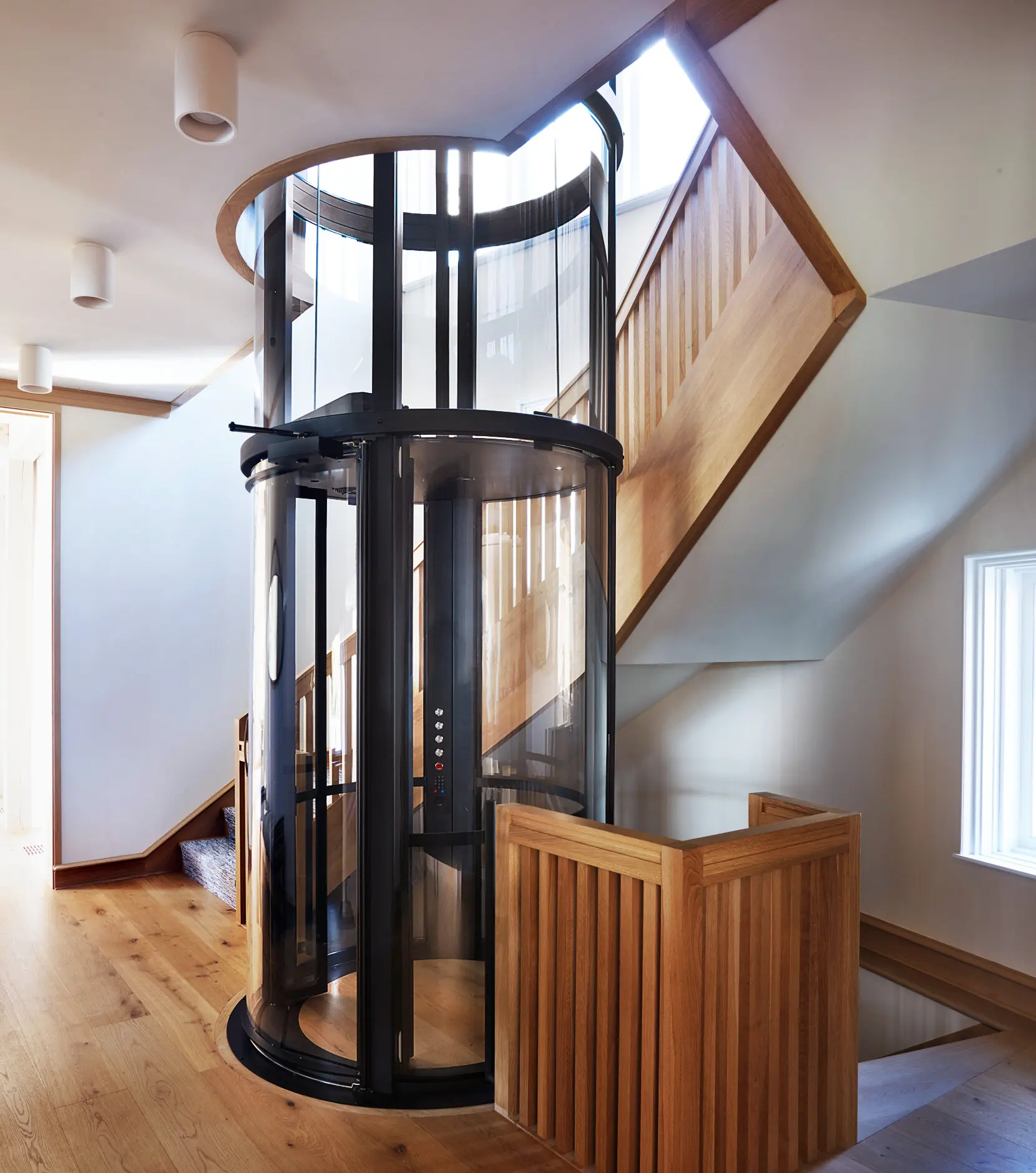
Since his family’s home is multilevel, Mr. Delaware decided to frame and wire the area around the staircase to later accommodate a pneumatic elevator. These tubelike glass or acrylic conveyances look sleek and modern, and generally take up less space than traditional elevators, Mr. Delaware said.
Still, they cost $45,000 on average, according to the home-improvement service Angi, generally more than a traditional elevator, and like all elevators, they are usually pricier when added to an existing home.


The Abramowitz-Rackham home also includes an elevator, which makes stops at all three levels, including a basement with an apartment for a potential live-in aide. There are also staircases with handrails inset with lighting, an original design. When the motion detectors sense movement, the railings illuminate.
“They’re so special, our dogs wait for the lights to turn on before they go downstairs,” Ms. Abramowitz said. “It was very expensive, but a manufacturer could do it relatively cheaply.”
In the front yard, the couple had a ramp built into a stone pathway surrounded by plants, camouflaging the accessibility feature.
Along with ramps and safer stairways, flooring can help ease mobility and reduce falls. Prioritize slip-resistant materials, Mr. Delaware said. For many rooms in his home, he selected luxury vinyl planking, which he attached using adhesive. If the planks are snapped together instead, the seams can split over time from wheelchair use, he said. Waterproof vinyl tiles, which resemble marble, can cost $1.49 per square foot, for example.
In bathrooms, choose showers, which are safer than tubs, said Ms. Morrison, the general contractor. If possible, opt for one with a curbless design and sufficient interior space for a wheelchair or aide, she added.
Don’t neglect grab bars. If they’re in the same material and finish as the surrounding bathroom fixtures, they should blend in. For instance, the Armand Grab Bar ($200) comes in oil-rubbed bronze, chrome, and brushed nickel.

Or make grab bars a striking design element. For a client’s shower, Matthias Hollwich, founding principal of the Manhattan-based firm HWKN Architecture, created a black grab bar inset with lighting.
“It looked awesome,” said Mr. Hollwich, who is also a co-author of “New Aging: Live Smarter Now to Live Better Forever.” “You could hold onto it, but it was more of an aesthetic element. This secondary light washed over the wall, for a beautiful atmosphere.”
Including both a detachable hand-held shower head and a stationary shower head will appear luxurious, plus accommodate standing and seated positions.

In showers, Christopher Boutlier, an interior designer based in Washington, D.C., often includes built-in benches. “We design the bench in the same stone or tile as the surround, so it looks intentional,” he said.
The acclaimed interior decorator Vicente Wolf incorporated a large, curved niche with an Indian lattice window into the shower in his Manhattan apartment. The niche doubles as seating and a sculptural focal point.

Comfort-height toilets are taller and generally more accessible than standard toilets, said Ms. Morrison, who also recommends a nearby grab bar. Standard toilets are lower, so “you have to put an ugly hospital seat on top, since it’s too far to bend down and lift yourself up,” she said. Expect to spend about $50 to $100 more for a comfort-height toilet and $100 to $300 more for a wheelchair-friendly toilet with a grab bar.
In kitchens, storage and appliance drawers in lower cabinetry and pull-down shelving in upper cabinetry help with accessibility, Mr. Delaware said. Induction burners are not only sleek in design, but they can also be a boon for safety since they’re free of open flames and hot coils. But they are typically pricier: A new unit with multiple induction burners can cost up to $3,000.

The designer Laura Lubin, who founded the Nashville-based firm Ellerslie Interiors, incorporated an induction cooktop in the kitchen and bar area of a pool house that will eventually house its owners, a couple who plans to age in place.
Fortunately, they won’t have to sacrifice style in the process.
Source: Dina Cheney, The New York Times, November 2, 2025
 the National Association of Senior & Specialty Move Managers® blog